Showing posts with label techniques. Show all posts

09 May 2015

Catching up

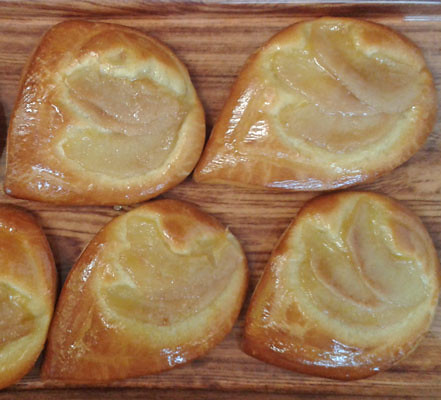
Well! Time to catch up on third quarter, especially since I'm now 4 weeks into my last quarter. I showed you some cakes and plated desserts in my last post; they were followed by doughs:

Pear Brioche After

(That is fresh pear brioche), by breads:
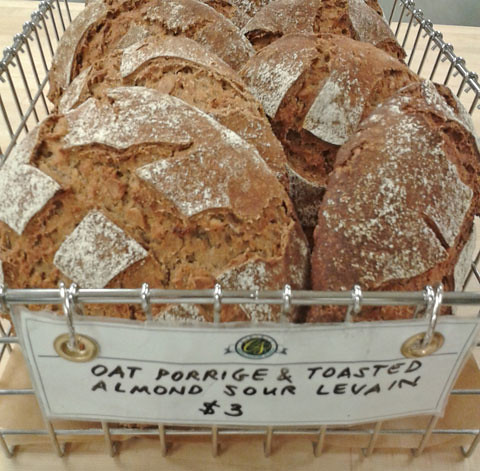
Tartine Oat Levain

(Sourdough, with oat porridge and almonds folded in), and tarts:
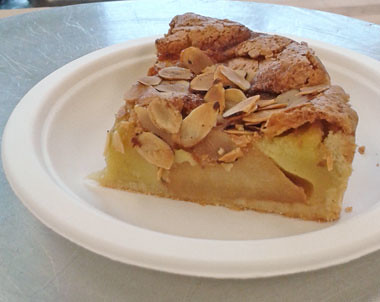
Tarte Normande

(Tarte Normande, big chunks of apple, and topped with sliced almond).

I made quite a few variations on what we call "three day breads." The technique for these is tuned to the rather unusual (for a bakery) hours we have to work on them. We're in the bakeshop from 9:00 a.m. until 1:30 p.m. each day, so we have to adjust rising and proofing times to suit, while still letting these breads develop the best flavors. The typical schedule is like this:

Day one:

Mix the preferment (sourdough-based starter) around noon, cover and leave out at room temperature overnight.

Day two:

Mix the preferment with the rest of the final dough ingredients except the salt (I do this by hand if I'm making the more-or-less standard 8 to 9 two-pound loaves). Cover the bowl and let it sit 30 minutes. This step is called "autolyse" and it lets the flour start to hydrate itself, and the enzymes in the flour a chance to start breaking down starches and proteins.

Then mix in the salt and put the dough in an oiled bin.

For the next 3 hours, fold the dough every 30 minutes. "Folding" means lifting the dough on one side and folding it over the main dough, then lifting the opposite side and folding over, then ditto for the two other sides. The folding serves the purpose of kneading and punching that you probably have seen in ordinary household bread recipes. It's wonderful to see how the dough develops between each fold, getting more lively, smoother, and developing that lovely sourdough smell.

After completing the folds, scale (cut the dough and weigh it in equal amounts - for us it's usually two pounds) and preshape the loaves. Often the preshape is a "loose boule" (soft round ball) but not always - the preshape depends on what you want your final shape to be. Let the preshaped loaves rest on a floured surface (bread board) for 15 minutes.

Do the final shaping of choice for the loaves, and put them in floured banettons (plastic bowls) or cloth-lined baskets. Retard (chill) overnight. We have a proof box that can have its temperature adjusted for either a warm or cool rise. A home baker equivalent would be to put the loaf in the fridge overnight. It will continue to develop but at a very slow pace.

Day three:

Take loaves out of the retarder and let them warm to room temperature - about an hour and a half. The loaves will revive and start to raise. When they are ready, turn the out of the baskets or banettons, slash them (this lets the crust open nicely when baking), and bake.

For you home-bakers, here is an excellent video showing how to use this same method for home bakers. It's from an Irish bakeshop and bread school called Riot Rye, whose mission is to empower people to make home-baked bread.

OK, that's the end of today's lesson! Next post I will explain the relevance of flowcharts to Pastry. Really!

24 August 2014

Baker's Percentage... with Biscuits

Professional baking has a language all its own. For example, a "formula" is a list of ingredients and quantities, which may or may not include instructions for how to make the bakery product. A formula that does include instructions can be called a recipe, but only if you want to sound like an amateur; in fact even needing instructions for common products (like creme anglaise or pate sucree) marks you as an amateur or, at best, a beginner. I'm only slightly exaggerating; by the time I finish third quarter at Seattle Culinary, I will be expected to have many common baking formulas memorized, and be able to produce them without referring to books or notes.

One aspect of professional baking formulas that has appealed to my engineer's mind is "baker's percentage" (sometimes called baker's math). The idea behind baker's percentage is that since most baked goods contain flour, you can express the quantity of other ingredients in a formula as a ratio (percentage) of the amount of flour. For example, if a recipe calls for a pound (16 ounces) of flour and 8 ounces of water, the percent of water is 8 divided by 16, which is 0.5 or 50%. Flour will always show as 100% in formulas using baker's percentage.

Cheese Biscuits

Photo of lovely cheese biscuits to take your mind off my possibly confusing explanation.

I can see some big advantages in using baker's percentage in a formula. The main advantage is that it allows easy and flexible scaling of the outcome of a formula. For example, a bread formula can be easily sized up or down to create the desired weight of dough for however many loaves the baker needs to make. Another advantage is that it encourages bakers to measure ingredients by weight, which will produce much more accurate and reproducible results (since for most ingredients like, say, flour, one person's cup measurement can contain a different amount of flour than another person's, due to handling of the flour, dry ingredients being packed down, and so on). A third advantage is that it provides a common language for writing formulas, independent of any particular weighing scheme (metric, imperial, whatever).

I'll use the cheese biscuits as an example. The original recipe (click here to view) called for:

8 ounces all-purpose flour
0.4 ounce baking powder
0.2 ounce salt
4 ounces cheese
8 ounces cream
total weight: 20.575
makes about 10 two-ounce biscuits

To convert to baker's percentage:

flour (8 ounces gives us a divisor of 8 for this formula) 100%
baking powder (.4 / 8) = 0.05 = 5%
salt (.2 / 8) = 0.025 = 2.5%
cheese (4 / 8) = 0.5 = 50%
cream (8 / 8) = 1.00 = 100%

Let's say you want to make 40 biscuits. You see it requires 8 ounces flour in the original recipe to make 10 biscuits, so you would need 32 ounces (4 times 8) to make 40. Then you can use the baker's percentages to calculate the other ingredients:

flour 32 ounces
baking powder (32 * 5%) = 1.6 ounces
salt (32 * 2.5%) = 0.8 ounce
cheese (32 * 50%) = 16 ounces
cream (32 * 100%) = 32 ounces

Easy as pie... or biscuits.