Showing posts with label classes. Show all posts

17 November 2014

Falling in

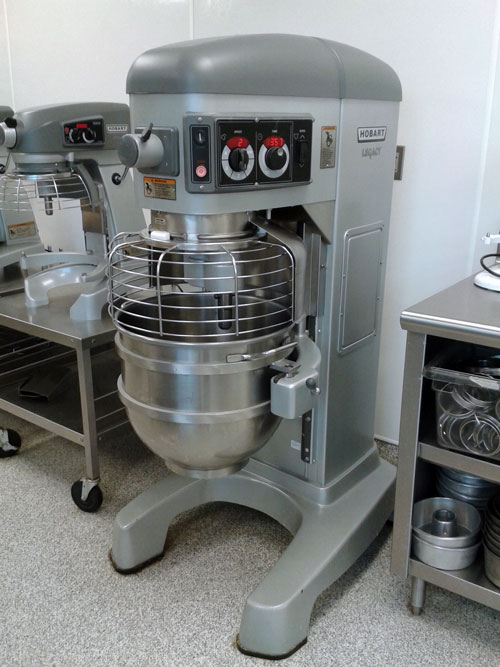
It's definitely fall here in Seattle, and I've fallen through seven weeks of the quarter without a single blog entry. I blame this beast:

The Boss

In a fit of wild optimism, I decided it would be fun to take a work-study job, doing the mixing of muffins and scones for the early shift at the Pastry Case. I did NO due diligence about hours and responsibilities, and oh have I paid for my ignorance. The job included more hours than I'd expected - 6 or 7 hours on Mondays mixing a week's worth of muffins and scones, plus an hour and a half Tuesday through Friday, baking from 6:30 am to 8.

But besides the hours, the work had more heavy lifting than it turns out this old baker can handle. The mixer above has a 60 quart stainless steel bowl that weighs about 30 pounds. Add 35 pounds of muffin batter to that and it's not an easy lift. 70 scones packed onto a full-size sheet tray is not light either. I was exhausted by the end of the day and started getting repetitive motion aches and pains and finally decided I had to quit. It took a week or two to find and train a replacement, but I am now happily free again. My replacement is a cheerful first-quarter student who loves the job (she is also about 1/3 my age and a head taller...).

So, enough about work! Second quarter is challenging in other ways. We have classes from Tuesday to Friday, with five rotations of two weeks duration. We also have a Baking 102 (baking theory) class from 8-9 each morning, and a Food Costing and Purchasing class twice a week from 2-3. From 9 to 1:30 each day we are working & learning in the Pastry kitchens.

There are nine of us in my quarter, still all women. So with five rotations, there is always someone who is alone (i.e. no partner). These are my rotations:

1. Culinary
2. Cakes
3. Viennoiserie (also known as Doughs)
4. Individual Desserts
5. Bread

For the Culinary rotation, we work in the culinary kitchens (they have four kitchens, to Pastry's two), and have different stations each day. Their kitchens are madhouses of activity, and I did not take any photos. The stations that I can remember were Fish (how to filet a trout), Sauces (making a basic red and a white sauce), Butchery (pork tenderloin), Starch (we got to choose a starch, and I chose potato gnocchi, which turned out beautifully), Breakfast (poached egg, hollandaise, pancakes, omelet), and Salad Dressing. I enjoyed the stations, and two of the chefs were very patient and attentive so I felt I learned quite a bit; also it was educational to see how the Culinary kitchens are run, but I felt it was a very brief overview... and it's our last time of working in Culinary. I did get a lot more practice on my knife skills, in any case.

So, Cakes! In first quarter, the cake rotation makes 'American style' cakes, like carrot cake and basic sponge cakes. In second quarter, we make European style cakes, with thin layers of rather dry sponge (that gets soaked in flavored simple syrup) sandwiched between layers of mousse and/or buttercream and/or jam/jelly. We also do more decor work with chocolate, caramel and marzipan. Here are some of the cakes we made:
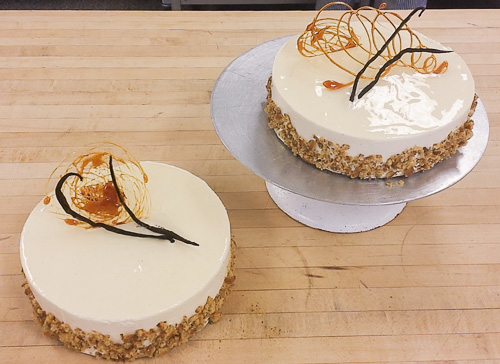
Eggnog Gateaux

Eggnog Gateaux: pumpkin cake with rum simple syrup and eggnog bavarian mousse. Caramel decor - those black sticklike things are whole vanilla beans.
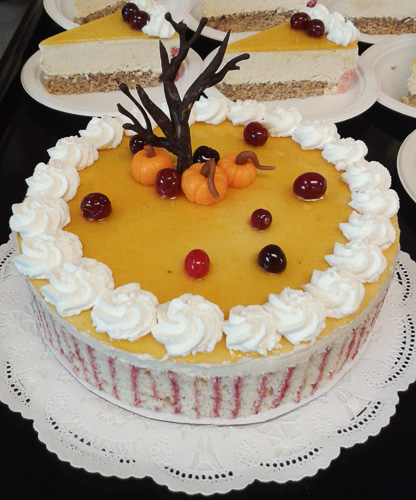
Pumpkin Mousse Cake

Curcurbita: pecan sponge cake, pumpkin cheese cake mousse, and swiss roll sponge with cranberry jam. Chocolate trees and marzipan pumpkins for decor. You can tell we made this one during Halloween week.

We also made opera cake (coffee buttercream and chocolate glacage), a caramel apple cake, and a spiced chocolate cake with passion fruit / apricot glaze and vanilla buttercream. All very rich, sweet cakes, that were fun to make but that I don't much care for to eat, or at least not more than a bite or two. Rich! Sweeeet!

I'll write about Viennoiserie in my next post.

20 April 2014

BAK 111 - Pastry Practicum


Hot Cross Buns

The BAK-111 class is the core of the Pastry program for first quarter. This is the time we spend working hands-on in the school bake shop, making "product" (baked goods and desserts) for sale in the pastry case (The Buzz) downstairs, and in the two school restaurants. This was my first week in the kitchen, and it was a bit of a rough start.

The course is structured into five two-week segments. For each segment, we work on one type of product. Spring quarter is a week shorter than Fall and Winter, so our first segment is only one week. Each segment is called a "rotation." With our small class size, we have only one or two students in each rotation at a time, and if there are two of us, the partners also change each time, so we have a chance to work with different people. On Tuesday and Thursday we work 10-1:30, and on Wednesday and Friday it's 9-1:30. I'll give you my rotations as an example:

Week 1: Breads
Week 2/3: Cookies
Week 4/5: Doughs
Week 6/7: Cakes
Week 8/9: Tarts

I have a partner for the first four rotations, but am on my own for the last one. There are three chefs who teach the different rotations. This week I had Chef Don for Breads. I don't know if all the chefs run their rotations the same way. Chef Don had us work under three 2nd quarter students. The chef demonstrated some things to us directly, but he is supervising all the students (all 4 quarters, about 20 people) who are doing breads/doughs, so he doesn't have time to hold anyone's hand. The 2nd quarter students did not seem to have much more experience than we did. I think the schedule was accelerated due to the one week rotation; but maybe it's always that busy in breads.

I did a good bit of dough prepping and shaping: baguettes, naan, 3-braid challah, and different buns. I also scaled some doughs ("scaling" is mise en place, i.e. getting all the ingredients weighed or measured and the pans prepared) and learned to use two of the big mixers. I learned how to refresh the levain (sourdough starter in dough form) that is used perpetually in the school bread-making. And I helped frost some hot cross buns that we made Friday (seen above). We don't get walked through all the steps of making something - there are several types of product being made at the same time in different stages, and we filled in and worked on whatever needed to be done moment to moment.

I also spent a lot of time washing bowls and pans and scraping out and washing the big mixers - two of them have bowls that are permanently attached and they are a big job to clean, especially when someone has let the leftover dough harden in them. The 3rd/4th quarter students work independently and seem to do their own cleanup, but the 2nd quarter students just piled up used bowls and pans, and we 1st quarters got to clean them at the end of the day. I am looking forward to third quarter.

I liked watching the 3rd/4th quarter students who were working at benches near us. I learned a lot of little things from them, for example, how best to scrape out the 20 quart mixing bowls. They were very friendly and patient with us 1st quarter students. Several of them told us that in first quarter the bread rotation was the toughest, and that our other ones would be much more fun. Encouraging words!

I made only two major mistakes this week. One was to put some leftover focaccia toppings (I forgot to mention we make focaccia mini-pizzas each day) into the walk-in freezer instead of the walk-in COOLER (they are next door to each other). Not sure how I mistook a freezer for a fridge; I blame light-headedness due to no lunch (did I mention that we had no breaks except for one day, because we were so busy?). Also, I forgot that the baking racks that sit out next to the rack ovens are always supposed to be considered hot unless proven otherwise, and I put my hand on one without testing it first. I let go very quickly and did not get blistered, but I think I won't forget THAT again.

Two more things I learned this week: before each rotation, read the chapter(s) in the Professional Baking text that cover the type of product I'll be making, to help avoid making ignorant mistakes; and when talking to a chef, never argue, never explain, and never apologize. "Yes, Chef" is an excellent response to any criticism, correction or direction.

This week: on to COOKIES.